A Garment on Display Is Not an Outfit in Motion: Questions to Ask at a Fashion Exhibition
A mannequin gives you one arrangement of a garment. Use a two-column museum worksheet to record visible details, question the display and keep movement, dressing sequence and missing accessories open to investigation.
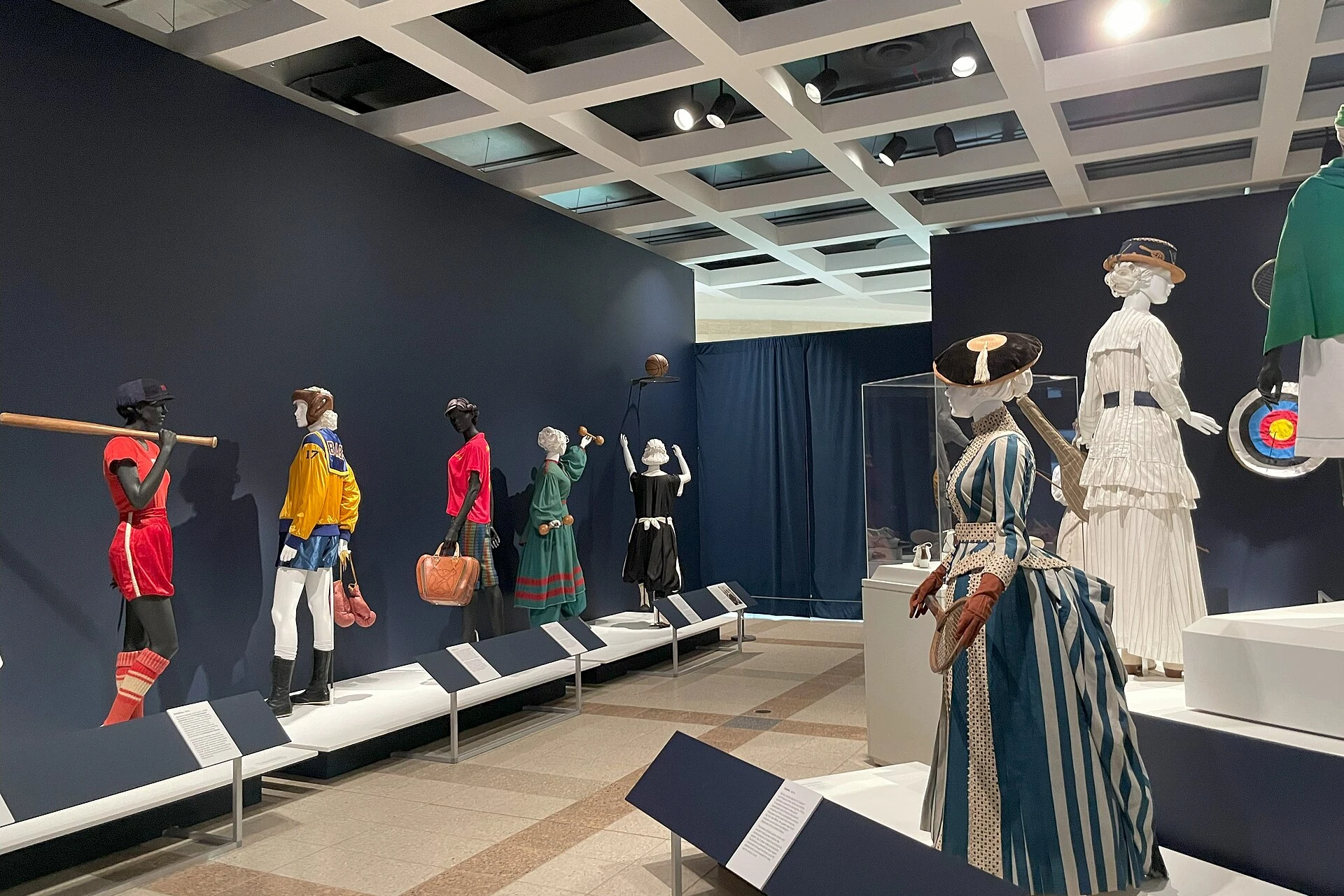

“The skirt clears the floor at the front. I cannot see the back hem.” That is a useful museum note: one visible detail, one clear limit. It gives you more to return to than “beautiful dress,” without turning a stationary display into a complete account of wearing it.
At a fashion exhibition, the garment and its presentation meet in front of you. A mannequin, a flat support, a viewing angle and any accompanying accessories all become part of the view. Your task is to notice what that particular arrangement lets you examine.
Describe the arrangement before interpreting the fit
Begin with a quick inventory. Is the garment upright on a mannequin, laid flat, suspended or visible only in a photograph? Can you see its front and back? Are the arms extended, lowered or absent? Does the case allow a side view?
These observations establish your viewing conditions. “The sleeve hangs away from the torso in this display” is more exact than “The sleeve was loose.” The first describes what is in front of you; the second may imply knowledge about its fit on a wearer.
Read the label for information about the presentation. If it identifies a support or explains an arrangement, note the wording. Where it gives no explanation, keep your description limited to what is visible. You do not need to diagnose why the museum chose a pose to examine its effect.
For a garment displayed flat, note which layers overlap and which surfaces remain hidden. A clear view of decoration across the front may still leave you unable to follow the side seams or understand the garment’s volume.
Keep a two-column worksheet
Copy this worksheet into a notebook before your visit. The entries are illustrative prompts, not observations about a named museum garment. Replace each one with a detail you can see and a question the display leaves open.
| What this display reveals | What remains uncertain |
|---|---|
| A skirt’s outline from the front | How the outline changes when the wearer turns or sits |
| The neckline as arranged on the mannequin | How it sat on a particular person’s body |
| A visible row of fastenings | Which fastening was opened first when dressing |
| Accessories included in the presentation | Whether these exact pieces were worn together |
| Decoration visible under the gallery lighting | How it would appear in another setting |
| The surface facing the viewer in a flat display | The shape and details concealed underneath |
Give each row one job. If you write “small waist, probably uncomfortable, formal evening dress,” split it apart. The waist is an observation needing careful wording; comfort is a question; “evening dress” should be tied to the label if that is where you found it.
Ask movement questions the pose cannot answer
Pick one ordinary action: taking a step, reaching forward, turning around or sitting down. Then identify the part of the garment that makes you curious. A long hem might prompt a question about walking; a fitted sleeve might prompt one about lifting an arm.
Write the question without supplying an imagined performance. “What happens to this sleeve when the elbow bends?” leaves room for an answer. “The wearer could barely move” closes the question before you have evidence.
Look for another view, a film or an explanatory label within the exhibition. If none answers your question, retain it. Do not handle the object or attempt to move part of a display. You can examine the same action using your own clothes later, while keeping that experiment separate from any claim about the museum garment.
Treat accessories and dressing order as questions
A hat, shoes or jewellery can make a displayed ensemble feel complete. Record which pieces are present, then check whether the label explains their relationship. “Shown with” is a useful description when you do not know whether the objects were originally worn together.
Absence deserves equally careful wording. No gloves in the case means no gloves are displayed there; it does not establish that gloves were never worn with the garment. Avoid filling the gap with a remembered image of a similar outfit.
Fastenings offer another productive line of inquiry. You may be able to see buttons or ties without knowing which are functional, which are concealed or how the wearer reached them. Sketch their visible positions and leave dressing order unresolved unless the display explains it.
For a present-day comparison of how accessories change an ensemble, use this guide to planning accessories across two events. Your own choices can illustrate styling possibilities without proving a historical pairing.
Choose one object to follow after the visit
Save the object title and any identifying number provided, along with the museum name and your question. “Dress, blue, second room” may be difficult to reconnect with a record later. Keep label wording separate from your own sketch and response.
The V&A collection listings distinguish statuses such as “On display,” “Not on display” and “View by appointment.” An online entry therefore needs a separate availability check when you are planning to see a particular object.
End your notes with one achievable follow-up: find a rear view, check an accessory’s identification or look for an explanation of the support. Give that question an object title and a date. You will have a useful starting point for another look.
Sources and editorial notes
Build an Occasionwear Reference Folder From Your Own Photos
Turn a handful of event photos into a useful dressing reference. Record venue, invitation wording and combinations you actually wore, then add the…
Build a Visual Glossary From Five Details in One Museum Object
Use five details from one object to build a visual glossary you can revisit. Pair small drawings with plain descriptions, verified terms and…
What a Fashion Plate Can—and Cannot—Tell You About Clothing
A drawn sleeve can reveal a silhouette without explaining its construction. Use a simple evidence table to separate visible details, printed descriptions and…