How to Read a Garden’s Layout From Two Viewpoints
Follow one urn from a straight path to a side bench. This imagined garden shows how to describe alignment, framing and overlap without knowing plant names.
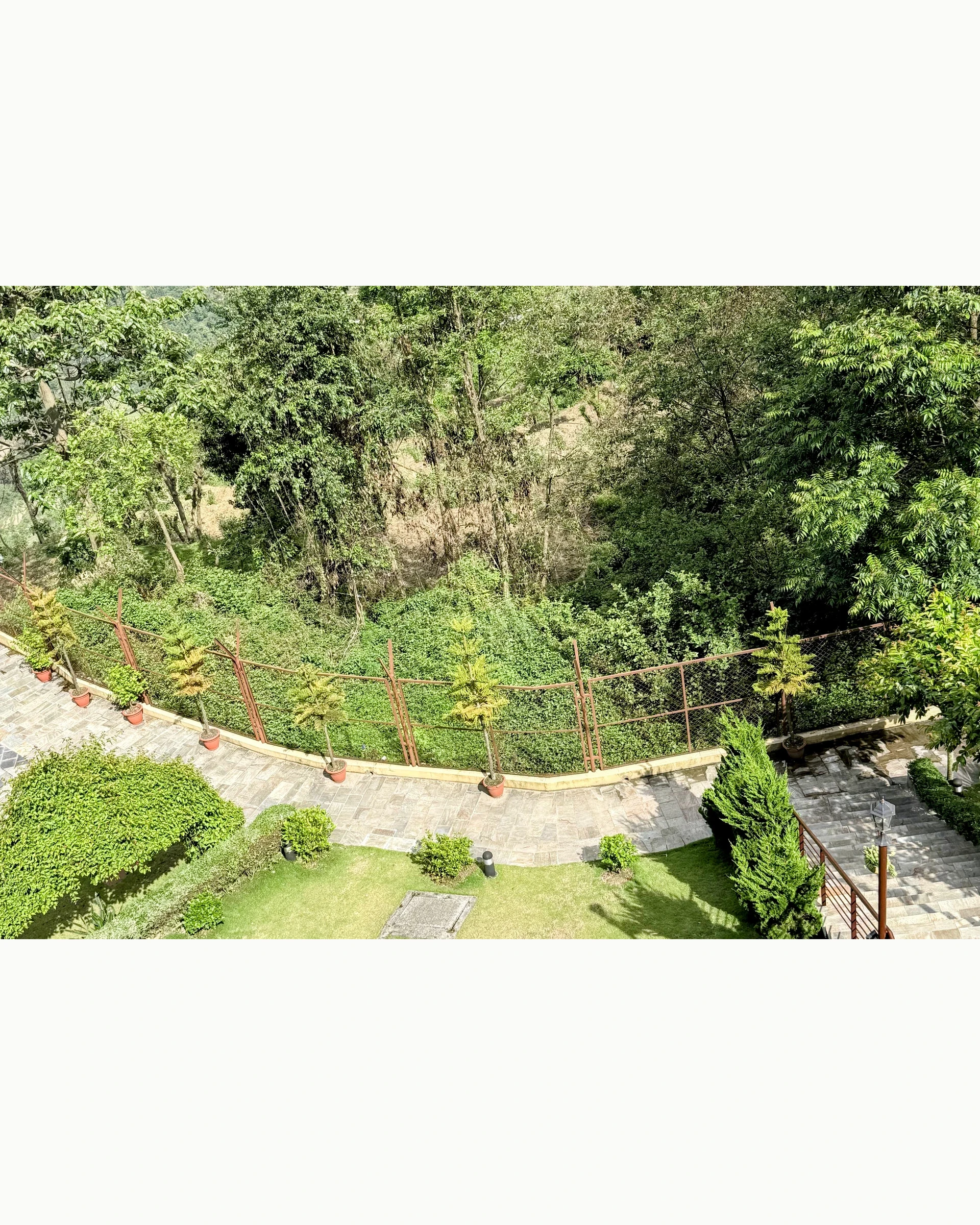
A stone urn stands at the end of a straight gravel path between clipped hedges. From the path entrance, you can see its whole outline. From a bench to the right, the nearer hedge hides its base. The urn stays in place; moving changes what surrounds and overlaps it.
This imagined garden is a worked example of reading layout without identifying plants. Follow the same feature from two positions and describe the change in its relationship to the path, planting and open space.
From the path: alignment and framing
At the entrance, the urn sits directly ahead on the line of the path. The hedges border the view on either side, with clear space around the urn’s outline.
Two terms help separate those observations. Alignment describes the urn’s position on the path’s forward line. Framing describes the hedge edges forming boundaries around the view. In this example, the urn is both aligned with the path and framed by the hedges.
A useful note would be: ‘The path runs straight towards the urn, and neither hedge crosses its outline.’ That records the arrangement without needing to name the planting or assign it a historical style.
From the bench: overlap and foreground
Now take the side bench. In this fictional view, the path runs diagonally across the scene. The nearest hedge occupies the foreground and overlaps the lower half of the urn; the rim remains visible beyond it.
Your second note could read: ‘The hedge hides the urn’s base. I can see its rim beyond the greenery, while the path crosses my view at an angle.’ Compare that with the first note: a fully visible object at the end of a path has become a partly concealed object beyond a hedge.
You might prefer either view. Describing the difference gives you something more precise to discuss than which position looks better.
Make your own two-view record
- Choose one fixed feature. Use a pot, doorway or seat visible from two accessible positions. Keep it as the subject of both notes.
- Write one sentence at each position. Include its relationship to a path or boundary and name anything that crosses its outline.
- Write the change. For the urn: ‘Moving to the bench puts the hedge in front of the base and turns the straight-ahead path into a diagonal.’
That final sentence is the result of the exercise: a specific account of how moving changes the view. It does not establish what a designer intended. To explore that question, you would need information beyond these two observations.
If you take photographs, include the surrounding path and planting so the relationship remains visible. Our guide to photographing a place through details offers a related way to choose a subject during a visit.
Where to Put Lunch in a Two-Neighbourhood City Break
Compare two bookshop-and-gallery schedules that give an extra 45 minutes to different neighbourhoods, then see how each handles a longer lunch.
How to Use a Map to Choose a River-Facing Train Window
Follow an invented railway through two bends to work out which side faces the river. Then reverse the journey and calculate the return…
Buying a Textile Souvenir: Record the Material and Care Details Before You Leave
A beautiful textile needs more than a place in your suitcase. Capture its stated material, measurements, care instructions and maker details while you…